Deadlock — 4 Conditions, Prevention
The Question
What are the four conditions for deadlock and how can you prevent it?
What a Strong Answer Covers
- All four condition names
- all must hold simultaneously
- at least one prevention strategy
Senior-Level Answer
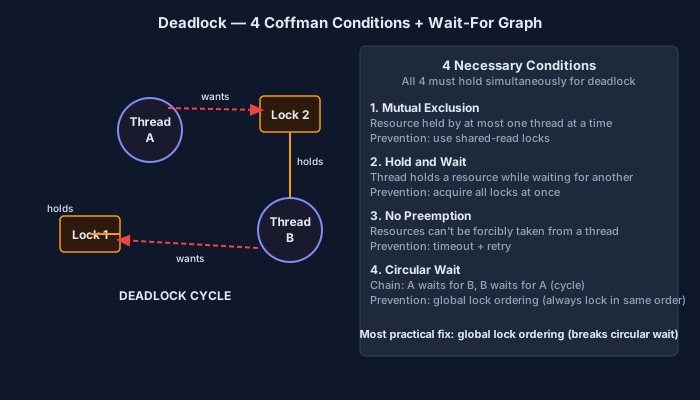
A deadlock is a situation where two or more threads are permanently blocked, each waiting for a resource held by another thread in the group. No thread can proceed because each is waiting for a resource that will never be released. For a deadlock to occur, all four of the Coffman conditions must hold simultaneously.
The first condition is mutual exclusion. At least one resource must be held in a non-sharable mode — only one thread can use it at a time.
The second condition is hold and wait. A thread must be holding at least one resource while waiting to acquire additional resources held by other threads.
The third condition is no preemption. Resources cannot be forcibly taken away from a thread. A resource can only be released voluntarily by the thread holding it.
The fourth condition is circular wait. There must exist a circular chain of threads, where each thread holds a resource that the next thread in the chain is waiting for.
All four conditions must hold simultaneously. If you can break even one, deadlock becomes impossible.
The most practical prevention strategy is breaking the circular wait condition by imposing a total ordering on resource acquisition. Assign every lock a numeric priority and require that all threads acquire locks in increasing order. If Thread A holds Lock 1 and needs Lock 2, it can acquire it. But if it holds Lock 2 and needs Lock 1, the ordering rule prevents it from requesting Lock 1 without first releasing Lock 2. This eliminates cycles in the wait graph.
To break hold and wait, you can require threads to request all needed resources atomically before beginning execution. If any resource is unavailable, the thread releases everything and retries.
To break no preemption, you can allow the system to forcibly revoke resources. If a thread cannot acquire a needed resource, it releases all currently held resources and retries later.
Beyond prevention, there is deadlock detection and recovery. Systems like databases often use a wait-for graph and periodically check for cycles. When a cycle is found, one transaction is aborted (the victim) to break the deadlock.
What Separates a 2/3 from a 3/3
2/3 — Passing but Incomplete
Candidate names all four conditions but gives only superficial definitions and does not clearly explain that all four must hold simultaneously.
3/3 — Strong Answer
Candidate names and clearly explains all four Coffman conditions, explicitly states they must all hold simultaneously, and provides at least one well-detailed prevention strategy (e.g., lock ordering) with enough specificity to implement it.
Common Mistakes
- Naming only two or three of the four conditions and guessing at the rest
- Forgetting to state that all four conditions must hold simultaneously
- Confusing deadlock with livelock or starvation
- Claiming that using timeouts on lock acquisition prevents deadlock — it mitigates but does not prevent it
- Giving only theoretical prevention without any practical strategy like lock ordering
Follow-Up Questions
- How do databases detect and resolve deadlocks? — Wait-for graph, cycle detection, abort the cheapest transaction (victim selection).
- What is the difference between deadlock prevention and deadlock avoidance? — Prevention eliminates one condition structurally. Avoidance uses runtime information (Banker's Algorithm) to deny risky requests.
- Can you describe a real-world scenario where lock ordering prevented deadlocks? — Bank transfers — always lock the lower account ID first, regardless of transfer direction.
- What is a livelock and how does it differ from deadlock? — Threads are not blocked but continuously change state without making progress.
- How would you debug a deadlock in a running application? — Thread dump (jstack), inspect wait-for graph, identify the cycle.
Related Questions
Can You Explain This Cold?
Reading the answer is step one. Explaining it unprompted — under interview pressure — is what actually matters. Get AI-graded feedback on your answer with follow-up probes on your weak points.
Get Graded — Free Assessment